Learning Objectives
- Explain why GSS cannot be generalized to multidimensional functions.
- Define the gradient as a vector of partial derivatives and interpret its magnitude and direction.
- Compute gradients analytically and evaluate them at specific points.
- Implement the gradient descent (GD) update rule and explain the role of step size \(\gamma\).
- Describe the steepest descent (SD) algorithm and how it selects the optimal \(\gamma\) at each step.
- Apply a convergence criterion based on the L2 norm of successive iterates.
- Implement GD as a MATLAB UDF that accepts a function handle and gradient handle.
Notation used in this lesson
Why We Need a New Approach
Golden Section Search is robust and efficient for one-dimensional functions, but it cannot be extended to higher dimensions. There is no multidimensional analogue of "the interval containing the minimum shrinks from both ends." A 2D function has infinitely many directions to explore, and bracketing along all of them simultaneously is impractical.
Many important physics and engineering problems involve minimizing functions of many variables — the energy of a molecular configuration (\(3N\) coordinates), the parameters of a fitted model, or the weights of a neural network. We need an approach that scales.
Gradient Review
Definition
The gradient is the multivariable generalization of the derivative. For a scalar function \(f(x)\) of an \(n\)-dimensional vector \(x = [x_1, x_2, \ldots, x_n]^T\), the gradient is the column vector of partial derivatives:
The gradient is itself a function of position \(x\). It has both a magnitude (how steep the function is at that point) and a direction (pointing toward the greatest rate of increase). At a minimum, the gradient is zero: \(\nabla f(x^*) = 0\).
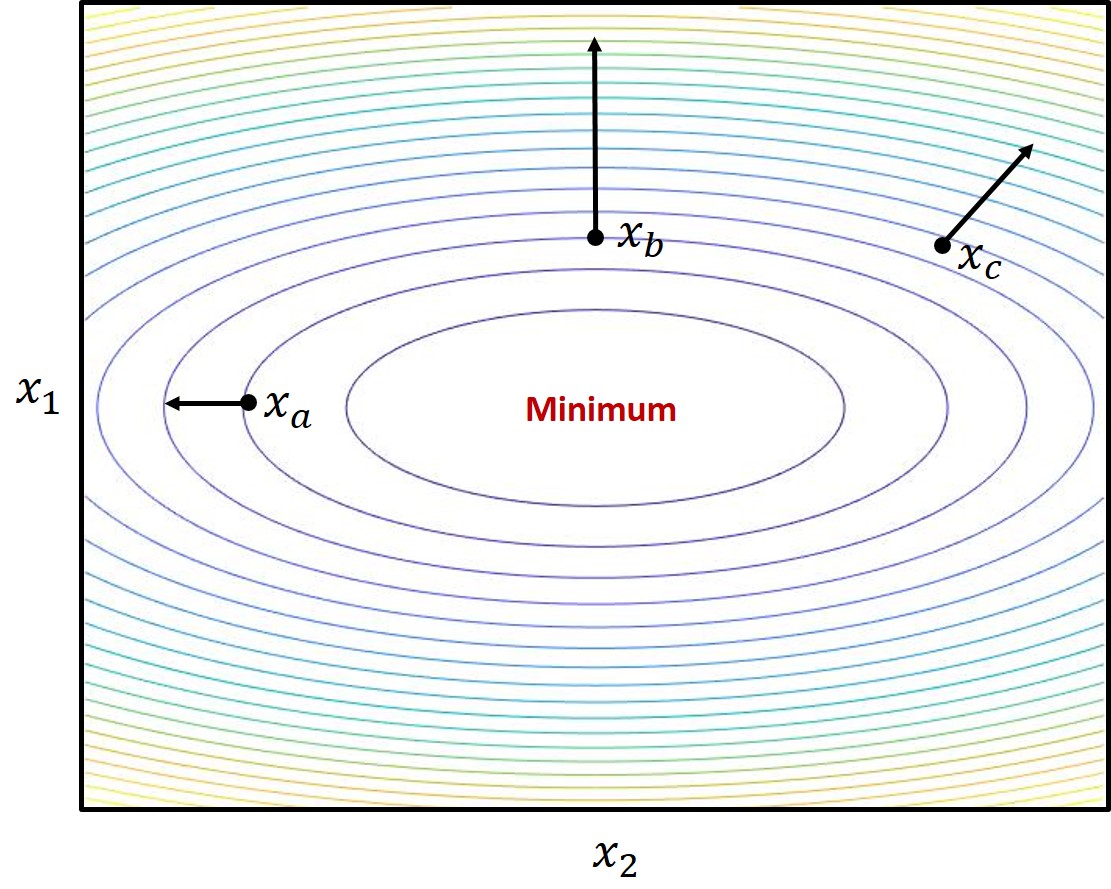
Example: \(f(x) = 4x_1^2 + x_2^2\)
This 2D quadratic has a minimum at the origin. Its gradient is:
Evaluating at three points:
| Point \(x\) | Gradient \(\nabla f(x)\) | Interpretation |
|---|---|---|
| \([0,\ -1]^T\) | \([0,\ -2]^T\) | Pointing straight down — move up to reach minimum |
| \([-1,\ 0]^T\) | \([-8,\ 0]^T\) | Pointing left — move right |
| \([-1,\ 1]^T\) | \([-8,\ 2]^T\) | Pointing left and up — move right and down |
Gradient Descent (GD)
Update rule
The gradient descent algorithm starts at an initial point \(x^0\) and repeatedly moves in the direction opposite the gradient:
where \(k\) is the iteration number and \(\gamma > 0\) is the step size (also called the learning rate). Because \(x\) and \(\nabla f\) are both vectors, this is a vector subtraction: each component of \(x\) is updated by a step proportional to the corresponding partial derivative.
The challenge of choosing \(\gamma\)
The step size \(\gamma\) is fixed for all iterations in basic GD and must be chosen carefully:
- \(\gamma\) too small: The algorithm makes tiny steps and converges very slowly — or may never reach the minimum within a practical number of iterations.
- \(\gamma\) too large: Each step overshoots the minimum. The algorithm bounces back and forth across the minimum and may diverge entirely.
- \(\gamma\) just right: The algorithm converges steadily to the minimum.
Steepest Descent (SD)
Optimal step size per iteration
Steepest descent uses the same update rule as GD, but instead of a fixed \(\gamma\), it finds the optimal step size at each iteration. The optimal \(\gamma^k\) is the one that produces the maximum decrease in \(f\) along the current gradient direction:
Note that \(f\bigl(x^k - \gamma\,\nabla f(x^k)\bigr)\) is a scalar function of the scalar variable \(\gamma\) only — \(x^k\) is the known current position, not a variable. This is a 1D optimization problem, which can be solved with GSS from Lesson 29.
Convergence and Stopping Criteria
Why convergence is not guaranteed
Gradient-based algorithms follow the local downhill path, regardless of whether it leads to the global minimum. Starting from a different \(x^0\) may lead to a different local minimum. For non-convex functions, the initial point matters.
As the algorithm approaches a minimum, \(\nabla f(x^k) \to 0\), so the update steps \(x^{k+1} - x^k = -\gamma\nabla f(x^k)\) also shrink toward zero. The algorithm slows down near the minimum — this is expected and not a sign of failure.
Stopping condition
A practical stopping rule is to halt when the change in position between consecutive iterates falls below a threshold \(\epsilon\):
where the L2 (Euclidean) norm of a vector \(v\) is
Alternative stopping rules include checking the magnitude of the gradient (\(\|\nabla f\|_2 \leq \epsilon\)) or the change in function value (\(|f^k - f^{k-1}| \leq \epsilon\)). All three are reasonable; in MATLAB, norm(x_new - x_old) computes the L2 norm directly.
Recommended Video
Dr. Trefor Bazett derives gradient descent directly from the directional derivative and multivariable calculus — framed as a general minimization method for high-dimensional functions, with no machine learning context.
Numerical Walkthrough — MATLAB
The script below manually steps through 5 iterations of gradient descent on \(f(x_1,x_2) = 4x_1^2 + x_2^2\) starting from \(x^0 = [1.5,\,1.5]^T\) with \(\gamma = 0.10\). Each step is written out explicitly so you can see exactly what the algorithm does. The true minimum is at \(x^* = [0,\,0]^T\).
%% Lesson 30 — GD: Hard-Coded 5-Step Walkthrough
% f(x1,x2) = 4*x1^2 + x2^2,   minimum at x* = [0; 0]
% grad f  =  [8*x1; 2*x2]
% Start: x0 = [1.5; 1.5],   gamma = 0.10

f      = @(x) 4*x(1)^2 + x(2)^2;
grad_f = @(x) [8*x(1); 2*x(2)];
gamma  = 0.10;

%% ── Step 0: evaluate gradient at x0, take one step ───────────────────────
x0 = [1.5; 1.5];
g0 = grad_f(x0);          % g0 = [12.0000;  3.0000]
x1 = x0 - gamma*g0;       % x1 = [ 0.3000;  1.2000]
fprintf('x0=[%7.4f, %7.4f]   f=%7.4f   |g|=%7.4f\n', x0(1),x0(2),f(x0),norm(g0))

%% ── Step 1 ────────────────────────────────────────────────────────────────
g1 = grad_f(x1);          % g1 = [ 2.4000;  2.4000]
x2 = x1 - gamma*g1;       % x2 = [ 0.0600;  0.9600]
fprintf('x1=[%7.4f, %7.4f]   f=%7.4f   |g|=%7.4f\n', x1(1),x1(2),f(x1),norm(g1))

%% ── Step 2 ────────────────────────────────────────────────────────────────
g2 = grad_f(x2);          % g2 = [ 0.4800;  1.9200]
x3 = x2 - gamma*g2;       % x3 = [ 0.0120;  0.7680]
fprintf('x2=[%7.4f, %7.4f]   f=%7.4f   |g|=%7.4f\n', x2(1),x2(2),f(x2),norm(g2))

%% ── Step 3 ────────────────────────────────────────────────────────────────
g3 = grad_f(x3);          % g3 = [ 0.0960;  1.5360]
x4 = x3 - gamma*g3;       % x4 = [ 0.0024;  0.6144]
fprintf('x3=[%7.4f, %7.4f]   f=%7.4f   |g|=%7.4f\n', x3(1),x3(2),f(x3),norm(g3))

%% ── Step 4 ────────────────────────────────────────────────────────────────
g4 = grad_f(x4);          % g4 = [ 0.0192;  1.2288]
x5 = x4 - gamma*g4;       % x5 = [0.00048; 0.49152]
fprintf('x4=[%7.4f, %7.4f]   f=%7.4f   |g|=%7.4f\n', x4(1),x4(2),f(x4),norm(g4))
fprintf('\nAfter 5 steps: x5=[%.5f; %.5f]   f=%.4f\n', x5(1),x5(2),f(x5))
fprintf('True x* = [0; 0],  f(x*) = 0\n')

%% ── Plots ─────────────────────────────────────────────────────────────────
pts   = [x0, x1, x2, x3, x4, x5];   % 2x6 matrix of all iterates
grads = [g0, g1, g2, g3, g4];        % 2x5 matrix of gradients at x0..x4

figure('Position', [100 100 1100 440])

%% Panel 1: contour + GD path + gradient arrows
subplot(1,2,1)
[X1,X2] = meshgrid(linspace(-0.3,1.8,200), linspace(-0.2,1.7,200));
F = 4*X1.^2 + X2.^2;
contourf(X1,X2,F,14,'LineColor','none');   hold on
contour(X1,X2,F,14,'k','LineWidth',0.4)
colorbar

% White connecting path (no legend entry)
plot(pts(1,:), pts(2,:), 'w-', 'LineWidth', 1.5, 'HandleVisibility','off')

% Color palette — one color per iterate x0..x5
clr = [0.55 0.55 0.55;   % gray   x0
       0.00 0.45 0.74;   % blue   x1
       0.85 0.33 0.10;   % orange x2
       0.47 0.67 0.19;   % green  x3
       0.49 0.18 0.56;   % purple x4
       0.64 0.08 0.18];  % red    x5

% Plot each iterate
for k = 1:6
    plot(pts(1,k), pts(2,k), 'o', 'MarkerSize', 9, ...
         'Color', clr(k,:), 'MarkerFaceColor', clr(k,:), ...
         'DisplayName', sprintf('$x_%d$', k-1))
end

% Gradient arrows — normalized to fixed visual length (direction only)
alen = 0.18;
for k = 1:5
    ghat = grads(:,k) / norm(grads(:,k));
    quiver(pts(1,k), pts(2,k), alen*ghat(1), alen*ghat(2), 0, ...
           'Color', clr(k,:), 'LineWidth', 1.8, 'MaxHeadSize', 0.6, ...
           'HandleVisibility','off')
end

% Dummy quiver for legend
hq = quiver(NaN, NaN, NaN, NaN, 'k-', 'LineWidth', 1.5);
hq.DisplayName = '$\nabla f$ (unit dir.)';

% True minimum
plot(0, 0, 'kp', 'MarkerSize', 14, 'MarkerFaceColor', 'k', 'DisplayName', '$x^*$')

xlabel('$x_1$', 'Interpreter', 'latex');   ylabel('$x_2$', 'Interpreter', 'latex')
title('GD path: $f = 4x_1^2 + x_2^2$,  $\gamma = 0.10$', 'Interpreter', 'latex')
legend('Location', 'southeast', 'Interpreter', 'latex');   grid on

%% Panel 2: f(x^k) vs. iteration (semilog)
subplot(1,2,2)
fvals = [f(x0), f(x1), f(x2), f(x3), f(x4), f(x5)];
semilogy(0:5, fvals, 'ko-', 'LineWidth', 1.8, 'MarkerFaceColor','k')
xlabel('Iteration');   ylabel('$f(x^k)$', 'Interpreter', 'latex')
title('$f(x^k)$ vs. iteration', 'Interpreter', 'latex')
grid on

sgtitle('GD Walkthrough: $f = 4x_1^2 + x_2^2$,  $\gamma=0.10$,  $x_0=[1.5;\,1.5]$', 'Interpreter', 'latex')
Summary
| Concept | Key Idea |
|---|---|
| Gradient \(\nabla f\) | Vector of partial derivatives; points toward steepest increase; zero at a minimum. |
| Gradient Descent | \(x^{k+1} = x^k - \gamma\nabla f(x^k)\); fixed step size \(\gamma\) for all iterations. |
| Step size \(\gamma\) | Too small → slow; too large → diverges. Must be tuned per problem. |
| Steepest Descent | Same update rule, but \(\gamma^k\) is optimized at each step via 1D GSS. |
| SD trade-off | Guaranteed maximum decrease per step, but 1D optimization at each iteration is expensive. |
| Stopping criterion | \(\|x^k - x^{k-1}\|_2 \leq \epsilon\); stop when steps become negligible. |
| Local vs. global | Both GD and SD converge to a local minimum; starting point matters for non-convex \(f\). |
References
- Pellizzari, C.A. Physics 356 — Supplement on Gradient-Based Optimization, USAFA, 2021.
- Bouman, C.A. Foundations of Computational Imaging, SIAM, 2022.
- Chong, E.K.P. and Zak, S.H. An Introduction to Optimization, 4th Ed., John Wiley & Sons, 2013, pp. 123–124.
- Wikipedia contributors. "Gradient." Wikipedia, The Free Encyclopedia, 2019.